Jimmy Choo Eyewear's Global OOH Campaign Across Fashion Capitals
Sally Langford
Oct 5, 2026

By Abinet TassewSep 17, 20265 min read
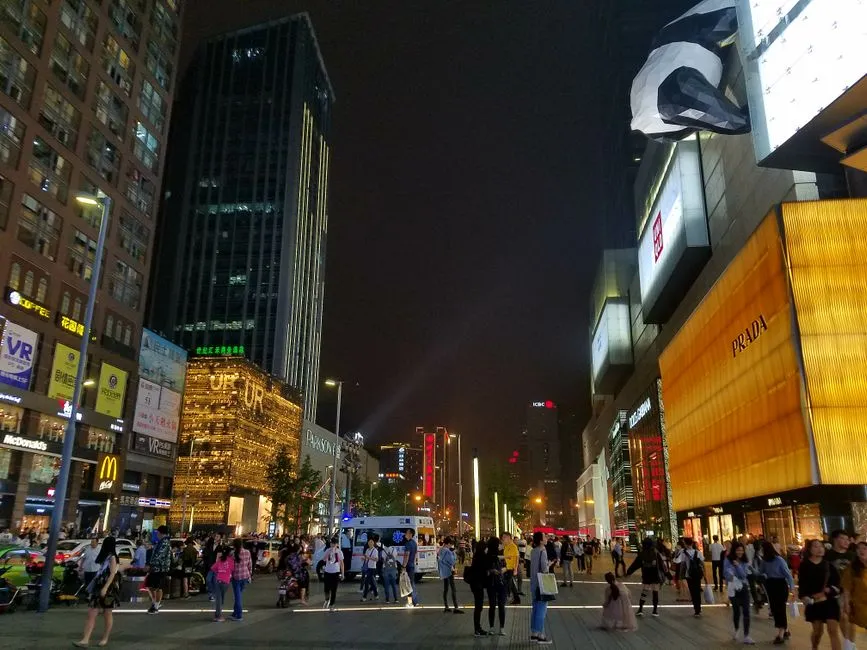
Chongqing and Chengdu are turning some of the world's most ambitious outdoor advertising into viral spectacles. The technique is called naked-eye 3D, and it works by building ultra-high-resolution LED screens that bend around the corner of a building. The illusion is designed for one ideal viewing angle—the angle most people film from—and when it hits, a cartoon dragon appears to leap from the wall, or a spaceship seems to crash through glass, or a waterfall pours down five stories into the street below.
These installations are expensive, highly engineered, and built with one clear goal: to get filmed. Brands are no longer asking how many people walk past the screen. They are asking how many people share it on Douyin, Weibo, or Instagram.
One of the most-watched examples is the "Light of Asia" installation in Chongqing's Guanyinqiao business district. The display spans multiple floors of a corner building and runs looping sequences of 3D animations—waves crashing, spacecraft landing, mythical creatures breaking through the frame. Pedestrians gather at designated spots on the sidewalk, phones out, to capture the optical trick at its most convincing.
The content is designed to compress well. Short clips, high contrast, clear motion, and a dramatic reveal in the first three seconds. That structure is no accident. Platforms like Douyin reward immediate visual impact, and brands have learned to design for the algorithm as much as the street.
Naked-eye 3D does not require glasses or headsets. Instead, it relies on a technique called forced perspective. The screen wraps around two adjacent walls, usually at a 90-degree corner, and the animation is pre-rendered to distort depth in a way that only resolves correctly from a specific vantage point.
From that spot, flat pixels appear to float in three-dimensional space. From anywhere else, the image looks skewed or obvious. So the displays include ground markings or barriers that guide crowds to the ideal filming position. The result is a kind of optical theatre—choreographed, controlled, and optimized for replay.
These projects require pixel pitches below 4mm, high refresh rates to avoid flicker on camera, brightness levels above 6,000 nits to remain visible in daylight, and custom content pipelines that account for the dual-plane geometry of the screen. Installation costs typically run into the millions, and campaigns are planned months in advance.
What makes Chongqing and Chengdu particularly fertile ground for this format is the blend of dense foot traffic, social-media-native audiences, and municipal governments that view large-scale digital infrastructure as a point of civic pride. Both cities have invested heavily in LED-lit skylines, and the aesthetic has become part of the local identity—futuristic, tech-forward, unapologetically loud.
Brands are treating the screens as content studios. A luxury car launch, a movie premiere, or a product drop can generate millions of impressions without buying a single digital ad. The screen itself becomes the campaign, and the audience does the distribution work for free.
The billboard is no longer the end product. The 15-second Douyin clip is. Brands are reverse-engineering creative briefs to start with the share, then work backward to the installation. What will make someone stop scrolling? What will make them repost it? The answer, increasingly, is spectacle that feels impossible—something that looks too big, too real, or too strange to have been faked.
Chongqing and Chengdu are leading, but other Chinese cities are deploying similar screens in high-traffic zones. Shanghai, Shenzhen, and Hangzhou have all launched naked-eye 3D projects in the past two years. The format is also appearing in Seoul, Tokyo, New York, and London, though the execution and audience behavior differ.
In China, the crowds gather with intention. Viewing spots become informal attractions. In Western cities, the reaction tends to be more spontaneous, and the content skews toward brand storytelling rather than pure spectacle. The cultural context shapes how the medium is used.
Naked-eye 3D is a display technique that creates the illusion of three-dimensional images without requiring viewers to wear glasses or use headsets. It typically uses high-resolution LED screens wrapped around building corners, combined with forced-perspective animations designed to look realistic from a specific viewing angle.
Both cities have dense urban populations, high social media engagement, significant municipal investment in digital infrastructure, and a cultural appetite for large-scale public spectacle. The combination makes them ideal test markets for brands experimenting with viral out-of-home advertising.
Costs vary widely depending on screen size, location, and campaign duration, but large-scale naked-eye 3D projects in tier-one Chinese cities typically require investments in the millions of dollars. This includes hardware, content production, permitting, and installation.
The 3D effect is real when viewed from the intended spot. The illusion is created through forced perspective and careful screen geometry, not post-production trickery. However, many clips shared online are filmed from the optimal angle, which maximizes the effect and can make it look more dramatic than it appears from other positions.
It already is. Cities in South Korea, Japan, the United States, and Europe have launched similar projects. However, the format works best in environments with high foot traffic, strong short-form video culture, and audiences accustomed to treating public installations as shareable content. The cultural fit matters as much as the technology.
Tell us the markets, the audience and the objective. Our specialists will build the plan and manage the campaign from briefing through to delivery.
Tell us the markets, the audience and the objective. Our specialist will come back with recommended formats, availability and next steps within 48 hours.
Share a brief and a specialist will come back with recommended formats, availability and next steps within 48 hours.